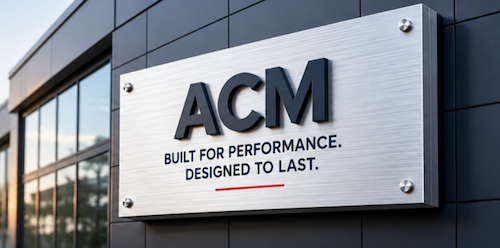
Liezle Barrie, National Sales Manager Consumables at Intamarket Graphics, says not all ACM signs are built the same. Walk through almost any shopping centre, business park or industrial area and you will see ACM everywhere.
It has become one of the most popular materials in the signage industry, and for good reason. It is lightweight, durable, versatile and creates a sleek, professional finish that works across a wide range of applications.
But here is something I have learnt over the years: just because two ACM signs look the same on the day they are installed does not mean they will perform the same over the next five years. In fact, some of the most expensive signage failures I’ve seen started with a sign that looked absolutely perfect on day one.
In today’s competitive market, it is easy to choose the cheapest ACM available. Unfortunately, that can become the most expensive decision in the long run.
Not all ACM is created equal. Yet many buying decisions are still made purely on price. Understanding how ACM is manufactured, the options available, and how those choices impact fabrication and long-term performance can make all the difference between a sign that lasts and one that fails prematurely.
The customer sees a flat panel or a fabricated letter with graphics applied to it. At Intamarket Graphics, these are often the conversations happening long before the customer ever sees the finished sign.
The signage industry sees something very different. We see the quality of the ACM itself, the coating system, the fabrication methods, the fixing methods, the expansion allowances, the installation environment, and
and a hundred small decisions that determine whether that sign will still look great years from now.
One of the biggest misconceptions about ACM is that it is simply a decorative panel. It is an engineered composite material consisting of two aluminium skins bonded to a core. That construction gives it its excellent strength-to-weight ratio, dimensional stability and durability, making it ideal for everything from storefront signage to wayfinding systems and large-format architectural branding.
But like many materials in our industry, performance depends heavily on how it is used.
Take outdoor installations as an example. ACM performs exceptionally well in external environments, but it is still subject to the realities of the world around it. Heat, cold, UV exposure, wind loading and moisture all place stress on a sign over time.
A panel that is not correctly fabricated or installed may begin to show issues long before the graphics themselves reach the end of their life. Sometimes the problem isn’t the material. Sometimes it’s the design. I’ve seen signs where insufficient support structures allowed movement in high winds. I’ve seen panels installed without considering thermal expansion.
I’ve seen fixings placed in ways that created unnecessary stress on the material. And when problems eventually appear, the ACM often gets blamed for something that was actually a specification or installation issue.
Another challenge is that ACM is frequently viewed as a commodity. A panel is a panel, right? Not necessarily.
Different ACM products can vary significantly in terms of coating quality, flatness, aluminium thickness, weather resistance and long-term performance. The differences may not be obvious when a sign is brand new. The real test comes after years of exposure to sunlight, rain, temperature fluctuations and daily wear and tear. That’s when material quality starts to matter.
Then there is fabrication. One of the reasons ACM is so popular is because it can be cut, routed, folded and shaped into a wide variety of forms.
It is important to remember that not all ACM is manufactured for fabrication. This is where the thickness of the aluminium skin becomes vital, as does understanding whether the panel you are purchasing has a breakable (often cheaper) or unbreakable core.
The quality of the aluminium itself also plays a role. Lower-cost ACM products may utilise thinner aluminium skins, higher levels of recycled aluminium or manufacturing processes that prioritise cost over consistency. While these products may appear similar when new, differences in rigidity, flatness, fabrication performance and long-term durability can become more apparent over time.
A panel designed purely for flat applications with a breakable core may perform perfectly as a sign face but become problematic when routed and folded into fabricated letters or trays. Achieving clean folds, accurate returns and professional finishes requires skill, experience and the right equipment.
A beautifully designed sign can still be let down by poor fabrication. And a premium material cannot compensate for shortcuts in production. The best ACM projects are usually the result of collaboration.
This is one of the reasons we spend so much time discussing applications with customers at Intamarket Graphics before recommending a solution.
The right ACM for a shopping centre directory may not be the right ACM for a coastal installation. The fixing method for a small wall sign may be completely different to that of a large architectural fascia. Even factors such as expected lifespan, environmental exposure and fabrication requirements can influence material selection.
Sometimes the most important part of a signage project is not choosing a product, it’s asking the right questions before the project starts. Those conversations can be the difference between a sign that simply looks good on installation day and one that continues to perform for years to come.
Designers, fabricators, installers, suppliers and clients all play a role in ensuring that the finished product not only looks good, but continues to perform throughout its intended lifespan. Because ultimately, successful signage is not judged on installation day. It’s judged years later, when the graphics still look sharp, when the panels remain flat, when the structure remains secure, and when the customer still feels proud every time they look at their brand.
ACM has earned its place as one of the most versatile materials in the signage industry. But like many things in our world, the material itself is only part of the story. The real difference lies in how it is specified, fabricated and installed. Because not all ACM signs are built the same.
INTAMARKET GRAPHICS
Tel: +27 11 444 0404
Email: inta@intamarket.co.za
Website: www.intamarketgraphics.co.za